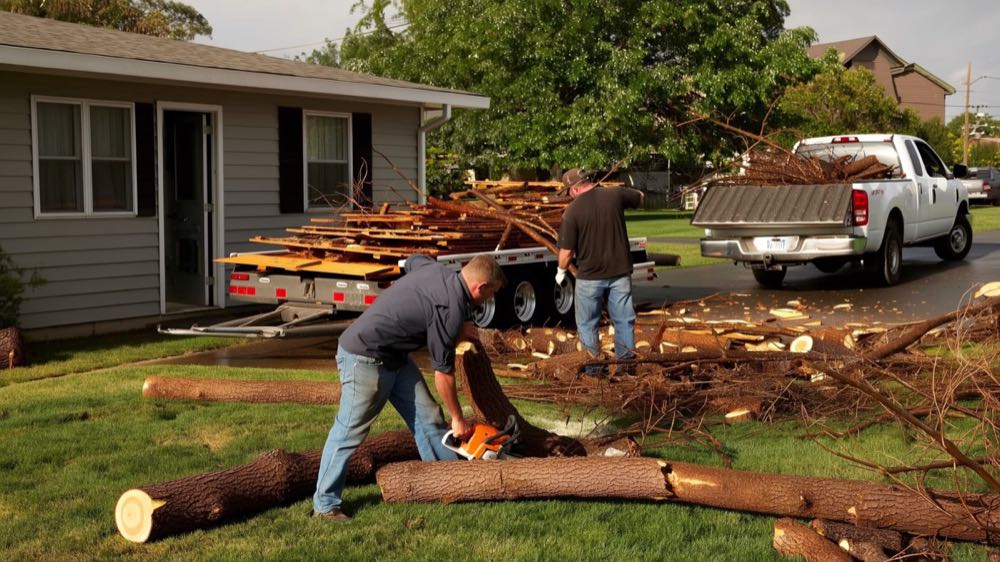
The Tennessee Valley gets its storms from March to May and again in the fall, and the morning after there are limbs in the yard, a fence on the ground and shingles in the beds. Storm debris removal is the morning-after call: we haul it. The everyday yard mess goes too: brush cleared off a lot line, rotted landscaping timbers, shrubs that died, the heap that grew behind the shed.
After a declared storm the city and the county run their own debris pickups; we tell you what they will collect for free and haul the rest.
What a storm and yard debris cleanup job involves
- Photo of the yard; quote by load
- Saws on the truck for limbs and anything still hanging
- Picked up and gone, normally a day or two after the storm passes
- Yard raked clear
What's included
- Saw work on limbs and anything still attached
- Loading limbs, brush, fence panels, roofing and shed pieces in one trip
- Hauling and disposal or mulching where the facility does it
- Raking the yard clear before leaving
- Advice on what the city's brush route would take free
Not this crew's job
- Cutting a tree off a house, a car or a power line, which is a tree crew and the utility first
- Roof tarping and structural repairs
- Debris at the street already claimed for a declared-disaster pickup
Storm cleanup across the county
The valley's storms come off the plateau in spring and again in late fall, and the morning after is the same in Hixson, Collegedale and on the mountain: limbs across the drive, a fence down, shingles in the flower beds. After the April 2020 tornado in East Brainerd and Ooltewah the city and county ran curbside debris passes for weeks, vegetation stacked separately from household trash. Most storms are smaller than that and there is no special pass; there is only the regular brush route and whoever you call.
The city's brush collection takes limbs and wood waste from single-family homes, but with limits: nothing longer than eight feet, thicker than eighteen inches or piled higher than four feet, placed at the street and clear of cars, mailboxes, meters and wires, on the property's scheduled collection week. Fence panels, roofing, lumber and shed pieces are on the refused list. What that leaves for a crew is anything too big for the limits, anything that is not vegetation, anything at an apartment or a business, and anything that cannot wait for the route.
Saws come on the truck for whatever is still attached, limbs are cut to size on the spot, and fence and roofing ride in the same load as the brush. When a whole neighborhood is hit the bookings are grouped by street so the truck stays close and nobody waits a week.
Storm and Yard Debris Cleanup pricing in Chattanooga
Storm and yard debris is priced by the load: about $240 to $325 for a quarter truck, $375 to $490 for a half, $540 to $650 for three quarters and $650 to $800 for a full truck. Cutting, loading, hauling and disposal are inside the number. A photo of the yard gets a firm quote back, and the crew names what the city's brush route would take free if you can wait for it.
For a yard plus a damaged deck or a roof tear-off after a storm, a 15-yard dumpster for the week often costs less than three truck visits, and the crew will say so.
Full price list and what moves the price →
Related: Bulk Trash Pickup in Chattanooga: What the City Takes and What It Won't, Junk removal in Hixson, Junk removal in Ooltewah. Official page: City of Chattanooga.
Storm and Yard Debris Cleanup questions, answered
Will the city pick up storm debris for free?
Some of it. Chattanooga's brush collection takes limbs and wood waste from single-family homes on the property's scheduled week, cut to no more than eight feet long and eighteen inches across and stacked no higher than four feet at the street. Fence panels, lumber, roofing and shed pieces are refused. After a declared disaster there are usually extra passes; after an ordinary storm there are not.
How fast can you get to a yard after a storm?
Usually within a day or two, and the same day for a driveway that is blocked. After a wide storm, neighbors who book together are reached faster because the truck can work one street before moving on. A tree on a house, a car or a power line is a tree crew's job and the utility's first; the hauling starts once it is on the ground.
What about the ordinary yard waste that is not from a storm?
The same crew hauls brush from a lot line, dead shrubs, old landscaping timbers, railroad ties and the pile that has grown behind the shed. Railroad ties and landscaping timbers count as lumber under the city's rules and are refused at the curb, so they are a crew job in any season.